

Close Menu

    Subscribe to Updates

    Get the latest creative news from FooBar about art, design and business.

    What's Hot

    Redefining High-End Manufacturing with All-Electric Injection Molding

    November 19, 2026

    Redefining High-End Manufacturing with All-Electric Injection Molding

    November 19, 2026

    Why Die and Blade Quality Matters in Pelletizing – Concord United

    November 19, 2026
    Facebook X (Twitter) Instagram
    Modern Plastics KoreaModern Plastics Korea
    • Demos
    • Demos
    • World
    • World
    • World
    • World
    • Politics
    • Politics
    • Politics
    • Politics
    • Buy Now
    • Buy Now
    • Buy Now
    • Buy Now
    • Demos
    • Demos
    Facebook X (Twitter) Instagram
    SUBSCRIBE
    Modern Plastics KoreaModern Plastics Korea
    Home»News»Technology & Innovation»The Next Evolution Of Metal AM Simulation Technology
    Technology & Innovation

    The Next Evolution Of Metal AM Simulation Technology

    Mital KumbhaniBy Mital KumbhaniMay 11, 2026No Comments6 Mins Read
    Facebook Twitter Pinterest LinkedIn Tumblr Reddit WhatsApp Email
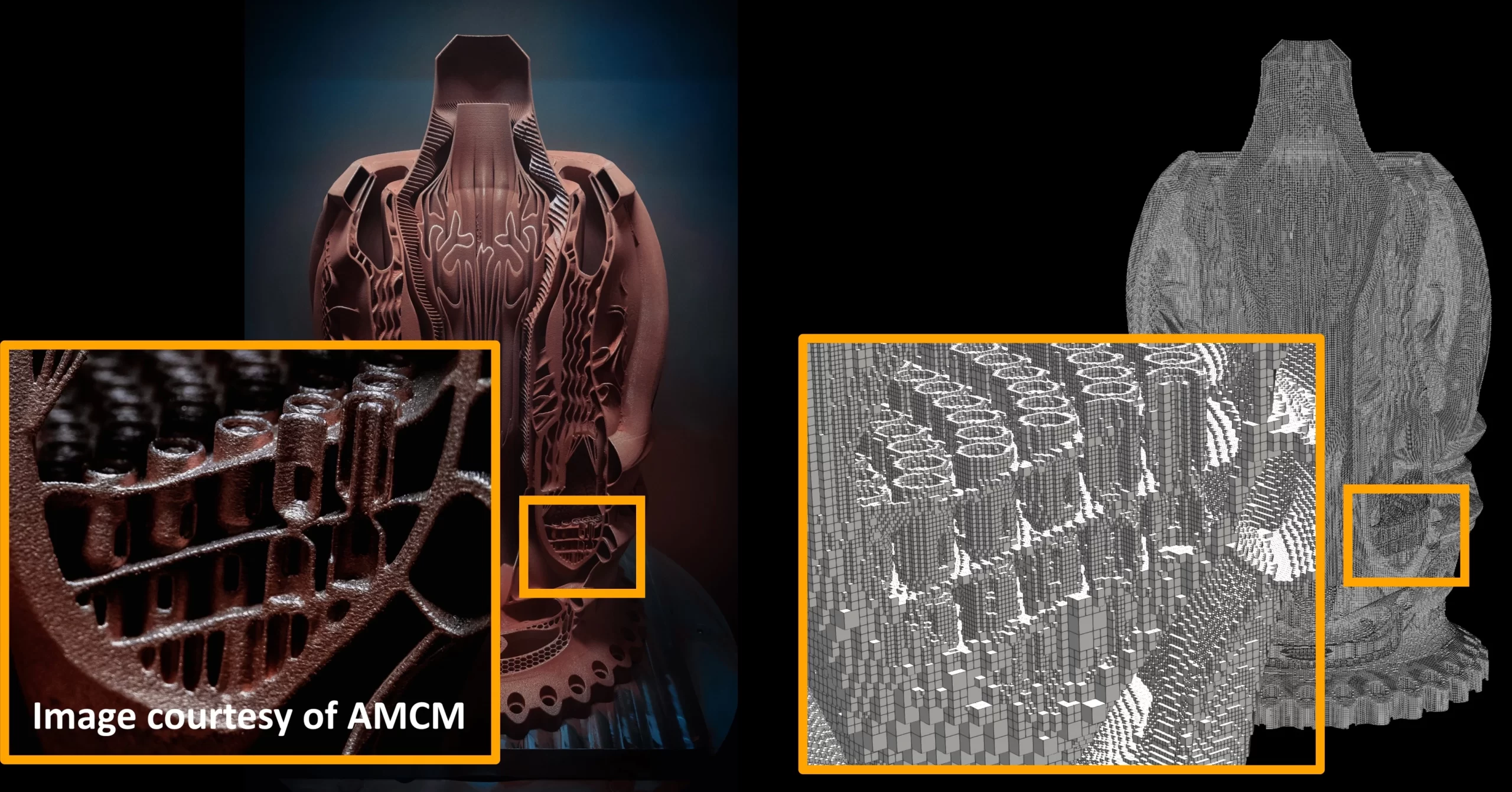
    Aerospike - Full-part LPBF aerospike FEA mesh (right) is able to resolve the smallest part features, as well as the entire build volume: 26M elements / 57M nodes.
    Share
    Facebook Twitter LinkedIn Pinterest WhatsApp Email

    The Next Evolution Of Metal AM Simulation Technology

    Evan Butcher, Principal Engineer – Additive Manufacturing, PanOptimization

    Between 2016 and 2020, a lot of organizations evaluated commercially available AM simulation tools. They took a handful of metal AM parts (usually coupons, demo brackets, simple manifolds) lined up a few software options, and asked a reasonable question, can you predict distortion?

    On the basis of those trials, budgets were spent, or the conclusion was reached that simulation was not scalable, too slow or not accurate enough to justify the effort. Ever since, the internal narrative in many companies has been, “We already looked at simulation.” The box is mentally ticked.

    The problem is that the world we are printing in now bears very little resemblance to the world those evaluations were designed for. The parts are different, the questions are different, the pace is different, and – critically – the software ecosystem is different. Treating a 2018 bake-off as definitive is no longer a neutral decision, it is an active constraint on what metal AM can achieve.

    This article is about what has changed, and what a modern evaluation of metal AM simulation and optimization needs to look like if you are serious about first-time-right production on high-value parts.

    “REAL” PARTS BROKE THE FIRST GENERATION OF TOOLS

    Most 2018 bake-offs were run on modest geometries: coupons, small brackets, simple manifolds. Even then, accuracy and speed were frequently not acceptable — which is one reason so many companies defaulted to trial and error as the practical route to printing parts.

    Today’s critical parts look very different. Part size and complexity have dramatically increased. Rocket hardware, dense heat exchangers, large structural components, and part-scale DED repairs push old simulation tools well past their computational limits. Mesh counts explode. Run times balloon. The solver simply fails, and teams fall back (explicitly or quietly) to trial-and-error.

    These are not cheap mistakes. With prints frequently reaching six-figure costs, an accurate and scalable simulation capability is needed to:

      • Make metal AM profitable
      • Increase machine throughput and uptime
      • Reduce costs associated with failed prints and rework
      • Shorten time to production and qualification

    PanX is an enabling technology designed specifically to solve the problems of modern AM. In practice, it is often the only production-ready solver that can handle these complex parts at the required model resolution and accuracy, and where older solvers can run, PanX typically runs 10–100× faster with superior accuracy.

    BEYOND JUST DISTORTION SIMULATION

    In 2018, the dominant question was: “Can you predict distortion?” Distortion still matters, but it isn’t the whole story, and it isn’t the same story for everyone.

    For engineers, the bar has moved. They want simulation to go beyond rough trend prediction and become a tool for:

      • Part design (orientation and features)
      • Part qualification (thermal history, defect risk, mechanical properties)
      • High-accuracy temperature and distortion/stress prediction
      • Process optimization (dwell-times, process parameters, geometries)

    And for leadership, the underlying question is even more direct. Can simulation help make metal AM profitable and predictable, rather than a high-cost experiment?

    A solver that only produces stress and distortion plots is misaligned with the decisions that actually govern flight readiness, warranty exposure, and program economics. PanX was built explicitly with those qualification-grade and business-critical questions in mind, not as a prettier way to look at the same old contours, but as infrastructure for how metal AM gets designed, qualified and run in production.
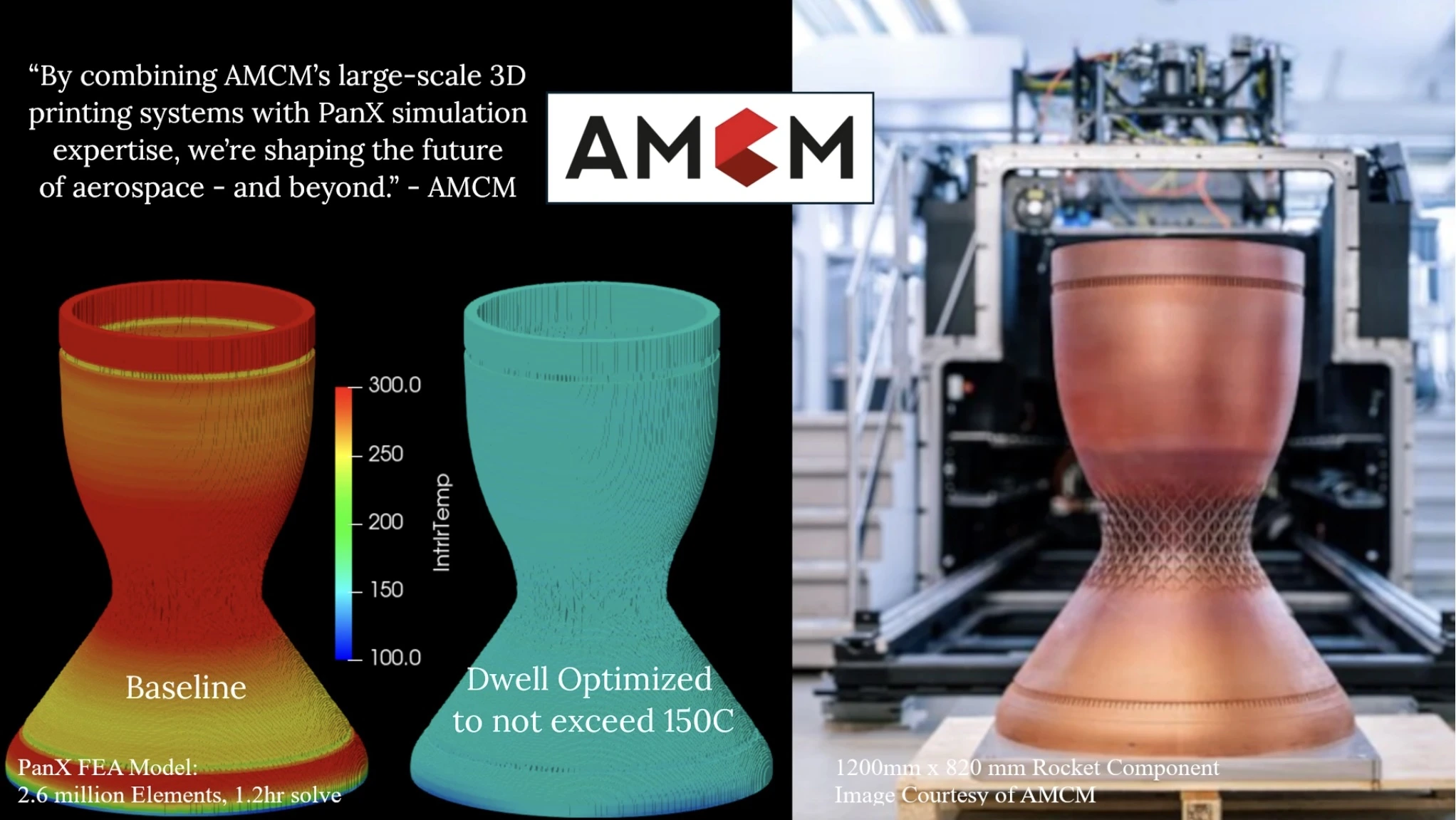
    PanX enables simulation and optimization of even the most complex parts. This AMCM M 8k component has dimensions of 820mm x 820mm x 1,200mm (image courtesy of AMCM)

    FROM STANDALONE TOOLS TO EMBEDDED INFRASTRUCTURE

    The simulation toolchain you evaluated in 2018 has moved on, or, in many cases, not moved at all. Old solvers have shrinking development teams, frozen roadmaps, or have been absorbed into portfolios where AM is no longer the priority.

    At the same time, OEMs and build-prep vendors now expose richer interfaces. That opens the door to something that simply wasn’t realistic in most 2018 trials: simulation as an engine behind your existing workflows, seamlessly feeding insight into the manufacturing strategy rather than living as a separate island.

    This is central to the 2026 vision for PanX: prediction plus optimization, delivered through OEM and ecosystem integrations so that engineers experience it as part of everyday work, not an extra task.

    RETHINKING HOW WE EVALUATE AM SIMULATION

    If you accept that parts, questions, pace, and ecosystem have all shifted, it follows that the way we evaluate tools must change as well. In our work with customers, a more realistic evaluation tends to have four characteristics.

    1. Use real production parts, not simple research/prototype parts.
    Include at least one geometry that genuinely stresses your current workflow (the heat exchanger, the large rocket component, the part-scale repair). If a tool can’t cope with that, it doesn’t matter how good it looks on a coupon.

    2. Measure throughput, not just one-off runtime.
    Ask how many meaningful scenarios can be run per week on hardware you are actually willing to buy. The ability to explore 200 variants in the same time an older code needs for two is a material competitive advantage.

    3. Tie metrics to qualification and economics.
    Frame success in terms of fewer failed builds, shorter time to a qualified part, and reduced uncertainty in critical regions, not just “did the displacement match a gauge within X%?”

    4. Consider the integration roadmap as a first-order criterion.
    Probe how the solver will connect to your OEM workflows and automation platforms over the next five years. A frozen codebase, however familiar, is not a neutral choice when your machines and requirements are moving.

    RE-OPENING THE CONVERSATION

    Re-examining a 2018 simulation decision is not an admission of failure, it is an acknowledgment that metal AM has grown up. If your flagship parts are larger and more complex, your qualification burden is heavier, your timelines are tighter, and your tools and evaluation criteria are unchanged, something has to give.

    The practical questions to ask inside your organization are straightforward:

      • Can our current tools handle the largest, most complex parts we actually care about, at useful run-times and resolution?
      • Do they answer qualification-grade questions, or only provide basic distortion plots?
      • Are they fast and robust enough to be used as a design and optimization engine, not just a report generator?
      • Is there a credible roadmap for OEM integrations and process optimization, or are we effectively on frozen code?
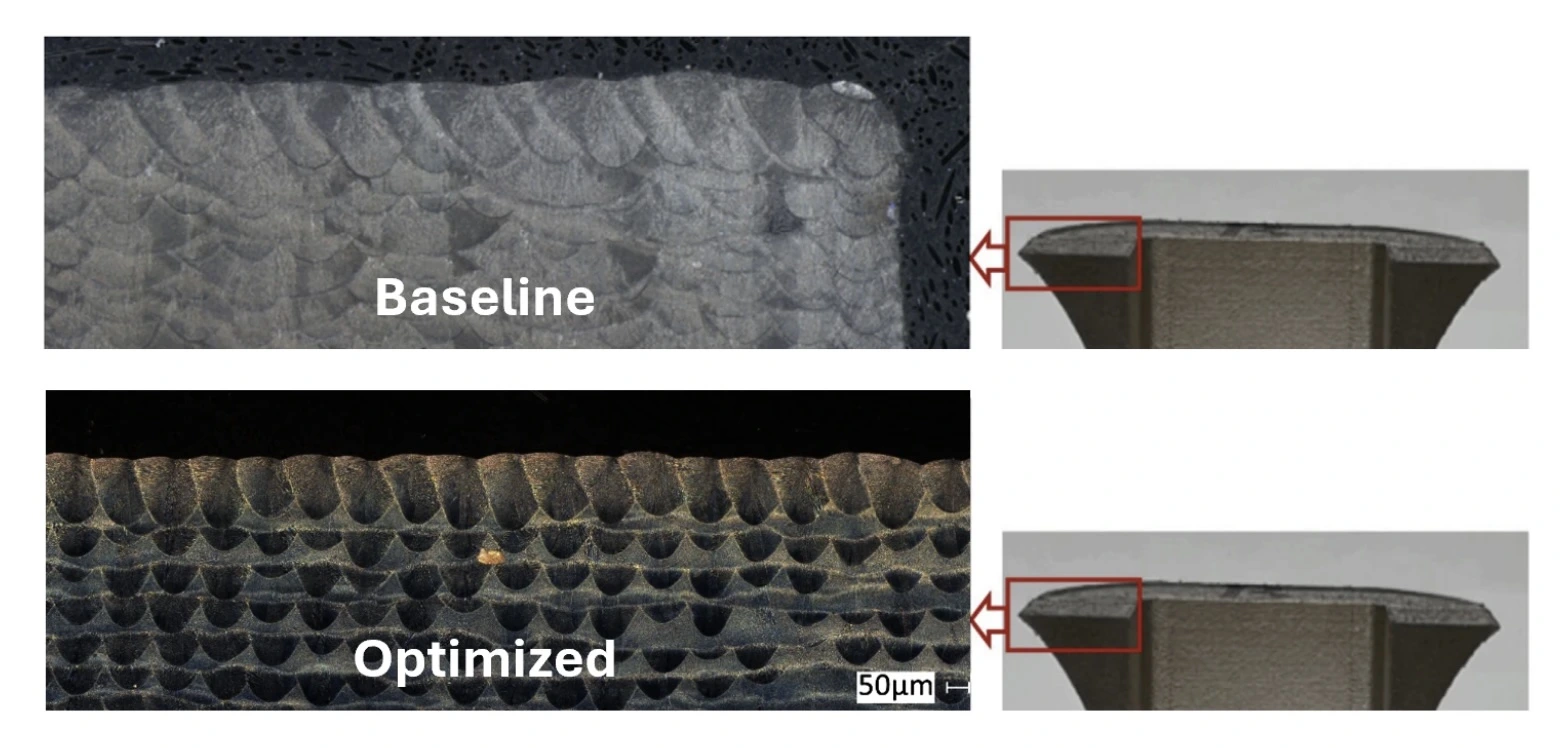
    PanX Feed-forward power optimization achieves uniform melt quality by varying laser power spatially across each layer based on the predicted interalyer temperatures.

    If the honest answers are uncomfortable, your 2018 evaluation has expired. The opportunity is not simply to swap one solver for another, but to treat simulation and optimization as core infrastructure for how metal AM is designed, qualified, and run in production.

    That is the mindset shift we see in the organizations getting the most value from PanX, and it is the shift the wider industry will need if we want metal AM to move beyond isolated successes and into reliable, large-scale, economically compelling production.

    panoptimization.com/

    #panoptimization #Modernplasticsindia #Pasticsnews #ModernPlasticsIndiaMagazine
    #PrintPublication #injectionmouldingworld #modernplasticsnepal

    Author

    • Mital Kumbhani
      Mital Kumbhani
    Mital Kumbhani

    Related Posts

    Aduro Clean Technologies Announces Strategic Capital Raise

    June 30, 2026

    Aduro Clean Technologies Announces Strategic Capital Raise

    June 30, 2026

    Empowering Modern Production With Superior Pellet Consistency

    June 12, 2026

    Comments are closed.

    Don't Miss
    Injection Moulding

    Redefining High-End Manufacturing with All-Electric Injection Molding

    By Ankit PrajapatiNovember 19, 20260

    Redefining High-End Manufacturing with All-Electric Injection Molding Demand for micron-scale components is growing in medical,…

    Redefining High-End Manufacturing with All-Electric Injection Molding

    November 19, 2026

    Why Die and Blade Quality Matters in Pelletizing – Concord United

    November 19, 2026

    Why Die and Blade Quality Matters in Pelletizing – Concord United

    November 19, 2026
    Stay In Touch
    • Facebook
    • Twitter
    • Pinterest
    • Instagram
    • YouTube
    • Vimeo
    Our Picks

    Redefining High-End Manufacturing with All-Electric Injection Molding

    November 19, 2026

    Redefining High-End Manufacturing with All-Electric Injection Molding

    November 19, 2026

    Why Die and Blade Quality Matters in Pelletizing – Concord United

    November 19, 2026

    Why Die and Blade Quality Matters in Pelletizing – Concord United

    November 19, 2026

    Subscribe to Updates

    Get the latest creative news from SmartMag about art & design.

    Demo

    Recent Posts

    • Redefining High-End Manufacturing with All-Electric Injection Molding
    • Redefining High-End Manufacturing with All-Electric Injection Molding
    • Why Die and Blade Quality Matters in Pelletizing – Concord United
    • Why Die and Blade Quality Matters in Pelletizing – Concord United
    • New G-Max fprimus 13 turns Waste into Valuable Raw Materials Inhouse Recycling with Maximum cost Efficiency

    Recent Comments

    No comments to show.
    About Us
    About Us

    Your source for the lifestyle news. This demo is crafted specifically to exhibit the use of the theme as a lifestyle site. Visit our main page for more demos.

    We're accepting new partnerships right now.

    Email Us: info@example.com
    Contact: +1-320-0123-451

    Our Picks

    Large Study of COVID Vaccine Side Effects in Sweden

    January 12, 2020

    Coronavirus latest: Japan’s Vaccination Rate Tops 75% As Cases Drop

    January 10, 2020
    8.9

    Review: Denmark Proposes Corona Pass Mandate for Workers

    January 9, 2020
    New Comments

      Archives

      • November 2026
      • October 2026
      • September 2026
      • August 2026
      • July 2026
      • June 2026
      • May 2026
      • April 2026
      • March 2026
      • February 2026
      • January 2026
      • December 2025
      • October 2025
      • September 2025
      • August 2025
      • July 2025
      • June 2025
      • May 2025
      • April 2025
      • March 2025
      • October 2021
      • September 2021
      • May 2021
      • April 2021
      • March 2021
      • January 2021
      • August 2020
      • March 2020
      • January 2020

      Categories

      • 3D Printing
      • 3D Printing & Prototyping
      • Achievements
      • Ancillary Equipment
      • Automation & Robotics
      • Automation Update
      • Automotive
      • Automotive & Mobility
      • Awards & Recognition
      • Bio-Plastics
      • Blow Moulding / Blow Molding
      • Circular Economy
      • Colourants & Masterbatch
      • Compounding
      • Driver & Motors
      • Engineering Polymers
      • Environment & Recycling
      • Environment & Sustainability
      • Exhibitions
      • Expansions & Appointments
      • Extrusion
      • Features & Insights
      • Flexible Packaging
      • Industrial Ecosystem
      • Industry News
      • Injection Moulding
      • Innovation
      • Interview
      • Lifestyle
      • Machinery & Equipment
      • Machinery Update
      • Manufacturing
      • Market Report
      • Markets
      • Material Update
      • Materials & Compounding
      • Medical & Healthcare
      • Medical Plastics
      • Micro Molding
      • Mould Making & Tooling
      • News
      • Opening & Expansions
      • Packaging & Printing
      • Packaging News
      • Packaging Update
      • Partnership
      • Pipe & Profiles
      • Politics
      • PRESS RELEASE
      • Printing & Packaging
      • Product
      • Product Launch
      • Recycling News
      • Research & Developments
      • Sheet & Pipe
      • Show News
      • Show News
      • Special Article
      • Sustainability & Recycling
      • Technology
      • Technology & Innovation
      • Technology News
      • Technology Study
      • Technology Update
      • Thermoforming
      • Thermoplastics
      • Uncategorized
      • World
      Facebook X (Twitter) Instagram Pinterest
      © 2026 ThemeSphere. Designed by ThemeSphere.

      Type above and press Enter to search. Press Esc to cancel.

      Powered by CookieAdmin
      Necessary cookies enable essential site features like secure log-ins and consent preference adjustments. They do not store personal data.
      None
      Functional cookies support features like content sharing on social media, collecting feedback, and enabling third-party tools.
      None
      Analytical cookies track visitor interactions, providing insights on metrics like visitor count, bounce rate, and traffic sources.
      None
      Advertisement cookies deliver personalized ads based on your previous visits and analyze the effectiveness of ad campaigns.
      None
      Unclassified cookies are cookies that we are in the process of classifying, together with the providers of individual cookies.
      None
      Powered by CookieAdmin